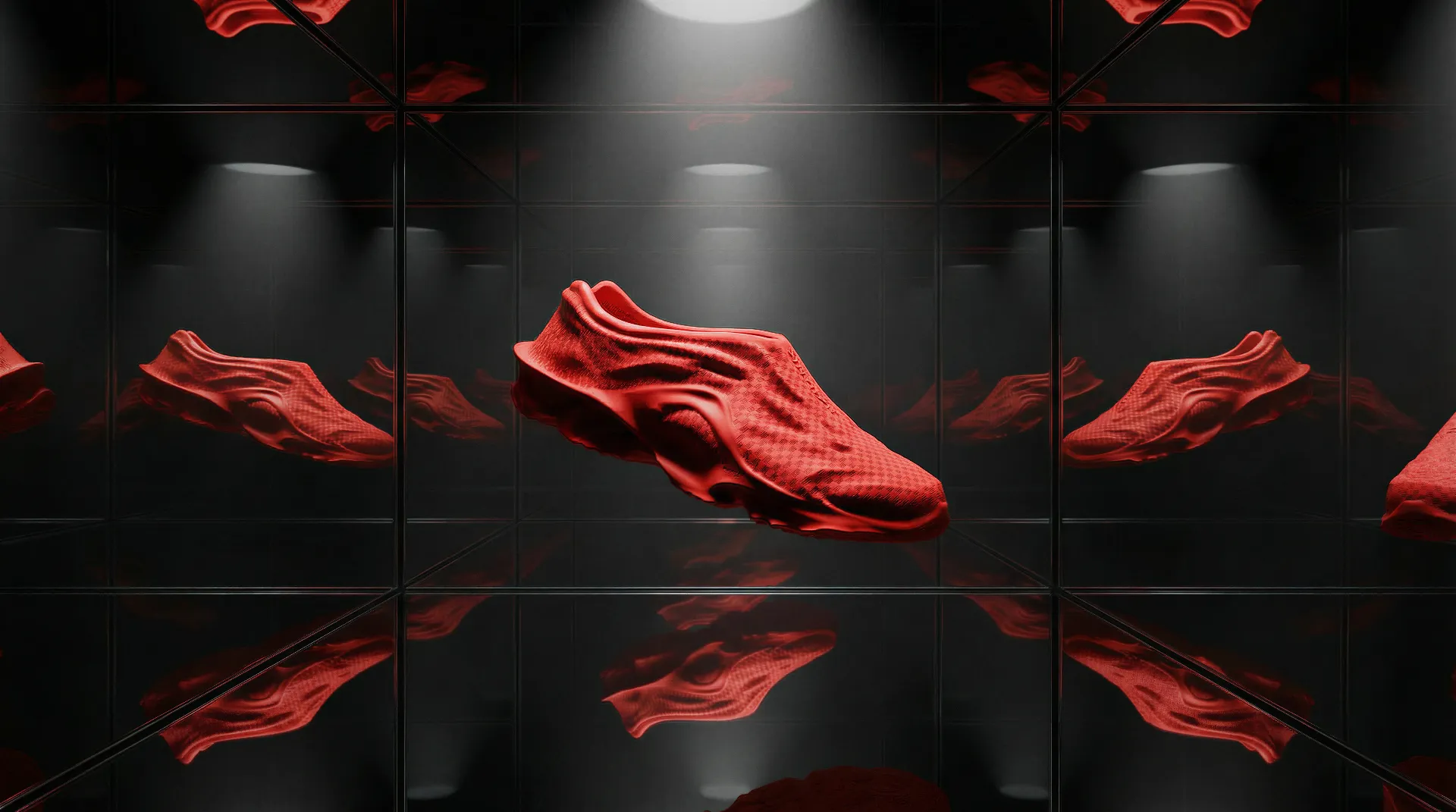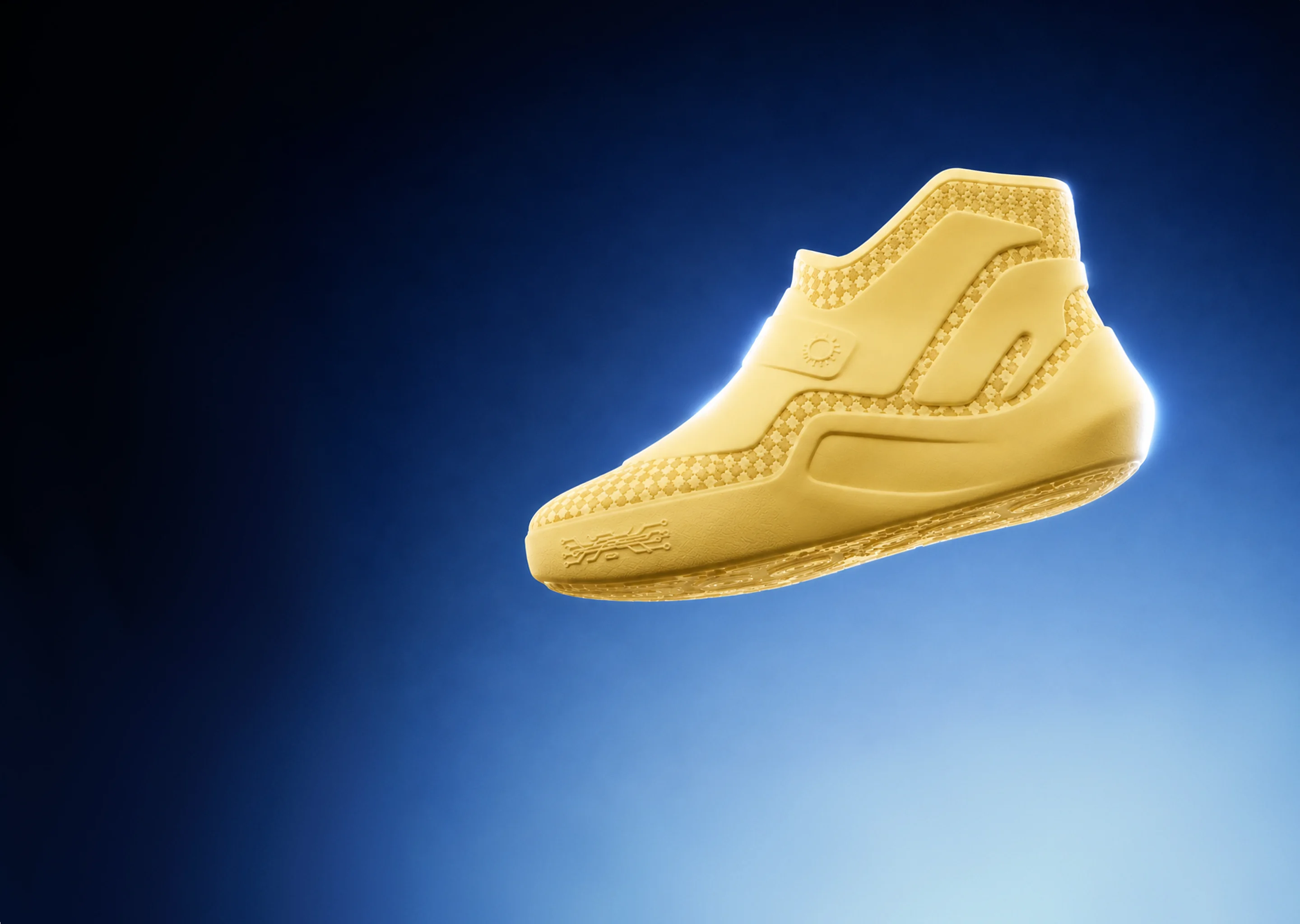
3D printed shoes have moved from futuristic concept to real-world footwear. Instead of relying entirely on traditional molds, cut-and-sewn components, foam midsoles, and large inventories of predetermined sizes, 3D printing makes it possible to manufacture footwear directly from digital designs.
But the bigger opportunity is changing what a shoe can be. At Syntilay, we’re using 3D printing alongside foot scanning and digital design to bring about a different model for footwear: SCAN → DATA → DESIGN → PRINT.
The goal is to move from footwear made for standardized sizes toward footwear made around the individual. So what exactly are 3D printed shoes? How are they made? What do they feel like? Can they be customized? And could 3D printing change the way we buy footwear? Here’s everything you need to know!
What Are 3D Printed Shoes?
3D printed shoes are footwear in which some or all of the physical shoe is manufactured using additive manufacturing. Traditional manufacturing often creates products by molding, cutting, stitching, gluing, assembling, or removing material. 3D printing approaches manufacturing differently.
A digital design is translated into physical geometry as material is formed into the desired structure. This allows designers to create shapes, internal structures, lattices, and geometries that can be difficult or impractical to manufacture using traditional footwear processes. Most importantly, the manufacturing instructions are digital. That changes what becomes possible.
How Are 3D Printed Shoes Made?
The exact process varies depending on the technology and footwear company. A simplified process looks like this: create a digital shoe design; prepare the geometry for manufacturing; send the digital file to a 3D printing system; manufacture the shoe or individual shoe components; complete any necessary finishing; and deliver the finished footwear to the customer.
At Syntilay, we’re taking that concept further by introducing another input: the customer’s foot. For eligible custom-fit Syntilay footwear, customers can scan their feet before their shoes are produced. That means the digital manufacturing process doesn’t have to begin with only a predetermined shoe size. It can begin with information about the person who will actually wear the product.
Can 3D Printed Shoes Be Customized?
This is one of the most exciting possibilities of 3D printed footwear. Traditional mass production works extremely well when a company wants to manufacture thousands or millions of similar products. Customization introduces complexity. If every product is different, traditional tooling, inventory, and manufacturing systems can become increasingly difficult to manage.
Digital manufacturing changes part of that equation. If the manufacturing instructions are digital, changing the digital file can change the physical product. That creates the possibility of producing different geometry from one customer to another. Instead of ONE DESIGN → THOUSANDS OF IDENTICAL PRODUCTS, the future looks like CUSTOMER DATA → INDIVIDUALIZED DESIGN → INDIVIDUAL PRODUCT. That’s the transition from mass production to mass personalization that we are building.
How Does Syntilay Make Custom 3D Printed Shoes?
At Syntilay, we believe footwear should start with the foot. For eligible custom-fit labeled products, the process begins with a foot scan. Customers can complete a scan using a smartphone. The scanning process captures information about the actual geometry of the feet rather than relying exclusively on a traditional shoe-size number.
That information can then become part of the digital process used to create the footwear. The basic idea is: choose your Syntilay shoe; scan your feet; turn the scan into digital foot data; use that information to inform the fit; 3D print the footwear on demand; and ship the finished pair to the customer. Your feet become part of the manufacturing process.
Why Is Foot Scanning Important?
Think about what a traditional shoe size tells you. If someone says, “I’m a size 10,” you know something about the approximate length category of footwear they typically wear. But you still don’t know everything about their feet.
You don’t necessarily know their width, arch profile, instep, heel shape, overall volume, foot contours, or left-to-right asymmetry. Two people can wear the same traditional shoe size and still have very different feet. That’s why we have combined 3D printing with foot scanning: manufacturing can respond to better information about the person receiving the product.
Do You Need to Know Your Shoe Size for 3D Printed Shoes?
3D printing creates the possibility of thinking differently about size. At Syntilay, our long-term question is simple: Why should a shoe only know your size when it can know your foot? A foot scan provides information that goes beyond a traditional size number. We believe that could eventually make the traditional question of “What size are you?” non-existent.
What Do 3D Printed Shoes Feel Like?
There isn’t one universal answer. Saying “What do 3D printed shoes feel like?” is similar to asking what traditionally manufactured shoes feel like. It depends on the design, geometry, material, structure, intended use, and manufacturing process.
One particularly interesting feature of 3D printing is the ability to create complex structures within the footwear. Instead of thinking only about a solid block of material, designers can experiment with lattices and other engineered geometries. The physical behavior of the product can therefore come not only from the material itself, but also from how that material is structured.
What Are Lattice Structures in 3D Printed Shoes?
Lattices are repeating or computationally generated three-dimensional structures. Imagine looking inside a conventional solid object and discovering an engineered network of interconnected geometry instead. By changing that geometry, designers can influence how different areas behave.
That opens up possibilities for experimenting with flexibility, support, compression, airflow, weight, responsiveness, and structural behavior. Instead of asking only, “What material should we use?” footwear designers can increasingly ask, “What geometry should we create with that material?” This is displayed clearly in our Syntilay PulsePodz model.
Are 3D Printed Shoes Flexible?
They can be. A common misconception is that 3D printed products must be hard, rigid plastic objects. But 3D printing is a manufacturing method, not a single material. The flexibility of a 3D printed shoe depends on its material, geometry, wall thickness, and overall construction.
A shoe can therefore be designed with areas that bend, compress, support, or respond differently. This is one reason 3D printing is so interesting for footwear. Feet move. Shoes need to move with them.
What Are the Advantages of 3D Printed Shoes?
1. Customization
Digital manufacturing makes it possible to change geometry between products without necessarily rebuilding an entire traditional manufacturing process. That can make custom-fit footwear accessible and scalable.
2. New Designs
Designers can experiment with structures that would be extremely difficult to create using conventional manufacturing. This will fundamentally change what footwear looks like and how it behaves.
3. On-Demand Manufacturing
Instead of manufacturing every possible product before knowing who will buy it, 3D printed footwear can potentially be manufactured after an order is placed. This changes the relationship between the customer and inventory and enables us to reduce waste.
4. Digital Inventory
A traditional footwear company may need physical inventory across combinations of models, colors, sizes, widths, and locations. With digital manufacturing, more of the value can exist as digital design files before the physical product is created. The inventory is digital.
5. Faster Design Iteration
When products begin as digital files, designers can experiment with new versions and structures without approaching every iteration exactly like a traditionally tooled product. This enables Syntilay to build on-trend footwear faster than ever before.
6. Mass Personalization
The biggest long-term opportunity is making personalization we offer online more scalable. Instead of making one product for everyone, digital manufacturing has helped us move toward making one product for one person. Custom-fit shoes that address your exact foot-support needs are finally here.
Are 3D Printed Shoes Sustainable?
3D printing is changing several aspects of footwear production, particularly around inventory and on-demand manufacturing. Traditional footwear requires companies to forecast demand: how many size 9s, how many size 10s, which colors, which stores, and which countries? Manufacture too little and you lose potential sales; manufacture too much and you’re left with excess inventory.
On-demand manufacturing introduces another possibility: Syntilay makes the product after someone orders it. By reducing dependence on speculative physical inventory, we are providing a solution to the industry’s overproduction problem.
Can an Entire Shoe Be 3D Printed?
Yes, footwear can be designed so that the entire shoe is created through additive manufacturing rather than simply printing one isolated component. Syntilay shoes have a mesh upper and a solid bottom, all printed. The same material is used throughout the shoes, but the internal structuring of the material is modified to produce different results.
Are 3D Printed Shoes the Future?
3D printing introduces capabilities that can disrupt the footwear industry: the ability to introduce a new footwear design language, the ability to give everyone a custom-made shoe, and the ability to manufacture on demand. That’s why we believe the future is personalized footwear enabled by digital manufacturing.
What Could the Shoe Store of the Future Look Like?
Today, you walk into a shoe store and ask, “Do you have this in my size?” Someone checks the shelf or stockroom. If your size isn’t there, you can’t buy it. Now imagine a different experience: you choose a design, your feet are scanned, your foot data is connected to the product, and your footwear is manufactured for you.
The store doesn’t necessarily need every possible size of every possible design sitting in the back room. Instead, the store becomes an interface between CUSTOMER → DATA → DIGITAL PRODUCT → MANUFACTURING. This model is live in Times Square at the tm:rw store with our Syntilay retail scanning experience.
3D Printing Can Change More Than Manufacturing
What’s interesting is removing some of the constraints that existed because of the old manufacturing system. If every product can be different, what happens to sizing? If products can be made on demand, what happens to inventory? If geometry can change digitally, what happens to customization? If a foot can become data, what happens to fit? The questions are powerful.
The Syntilay Approach to 3D Printed Footwear
At Syntilay, we’re building around a simple belief: your feet shouldn’t have to conform to footwear designed around an average. We’re combining foot scanning, digital foot data, computational design, 3D printing, on-demand manufacturing, and custom-fit footwear.
The goal is to move footwear from MASS PRODUCTION toward MASS PERSONALIZATION. As manufacturing has become digital, the shoe no longer has to be exactly the same for everyone.